
Investigating the new bio-based polyglycerol-based surfactants synthesised by SurfToGreen, as promising alternatives to conventional fossil-based surfactants in a wide range of applications (e.g. detergents, cosmetics, emulsions and creams), our partners INRAE and CSGI performed neutron scattering experiments at the Institut Laue-Langevin (ILL) in Grenoble.
Neutron scattering is particularly relevant for understanding how these new surfactants self-assemble in solution and in complex formulations, providing essential information on their structure and organization under different conditions.
This is a powerful experiment technique that provides detailed structural information that is difficult to obtain using other methods: it allows us to determine how surfactant molecules organise themselves into micelles and other aggregates, and to characterise their size, shape and internal structure. By varying experimental conditions, such as temperature, surfactant concentration and the presence of other molecules, we can investigate how these structures evolve and interact with their surrounding environment. A key advantage of neutron scattering is that it can be used not only in simple model systems but also in complex formulations, like the SurfToGreen applications.
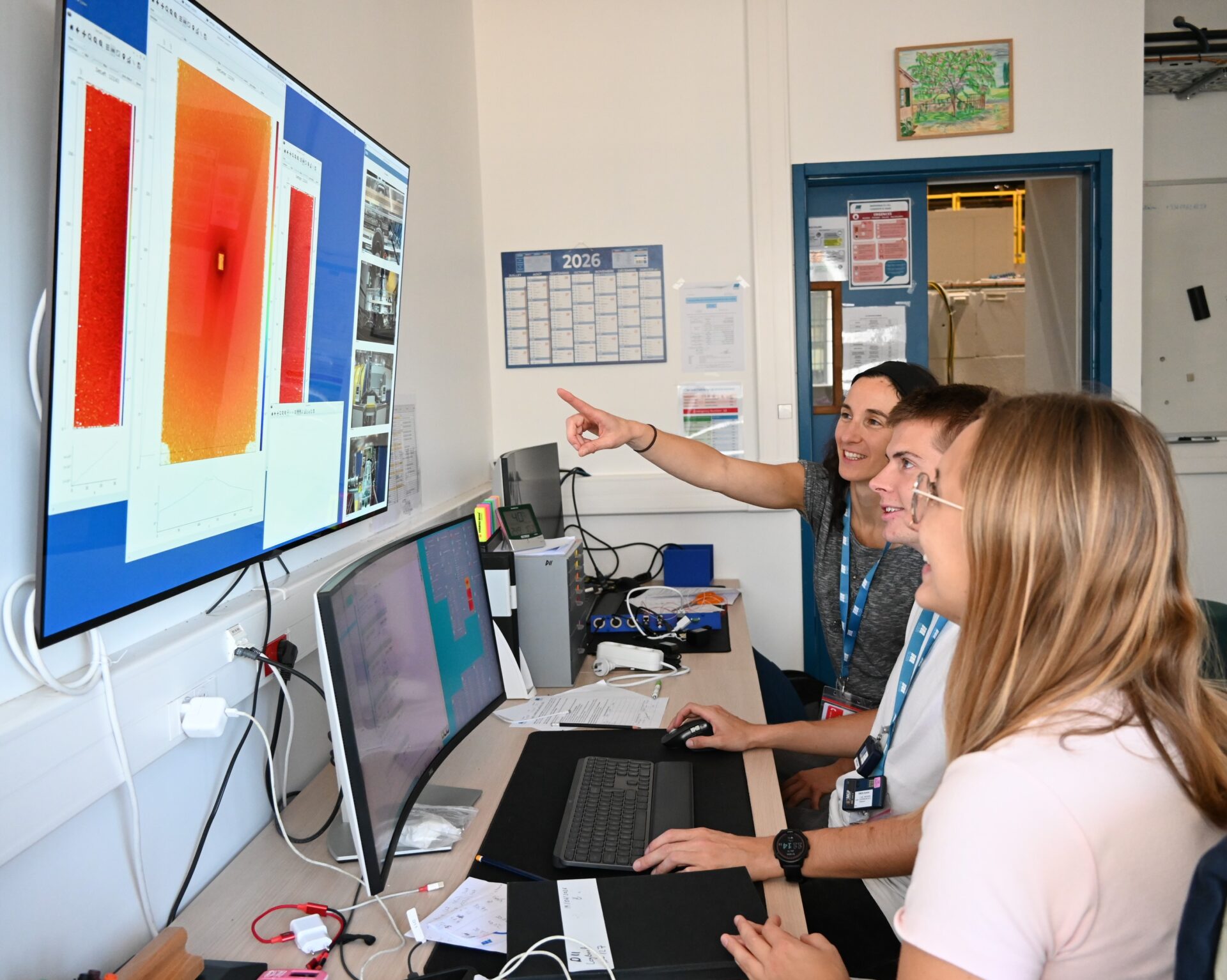
The data gained is essential to establish the relationship between surfactants molecular structure, their organisation in formulations and their final performance in real applications, thus helping in guiding the design and optimisation of SurfToGreen formulations. In particular, they will provide a scientific basis for selecting suitable surfactants and formulation conditions, and for understanding how changes in composition affect the structure and stability of the resulting systems. This knowledge will help bridge the gap between the synthesis of new surfactant molecules and their effective use in final products.
Why at ILL?
The ILL offers access to one of the world’s leading neutron research facilities, with a high-performance neutron source and state-of-the-art neutron scattering instruments. These capabilities are essential for investigating the structure of surfactant self-assemblies with a high level of detail, both in simple systems and in complex formulations. In addition, the ILL researchers provide outstanding scientific expertise in experimental design, neutron scattering techniques and data analysis: the close collaboration with them is particularly valuable for optimising the experiments, obtaining high-quality data and interpreting the results. This makes the ILL an ideal environment for addressing the structural challenges of SurfToGreen.